Florida's warm, wet climate is great for growing trees, and just as good for the fungi, insects, and bacteria that attack them. Most tree problems we see in Orlando yards are manageable if they're caught early. A few are not, and with those the goal shifts from saving the tree to removing it safely before it fails.
Here are four problems every Central Florida homeowner should be able to recognize, plus what we recommend when you see them.
1. Laurel Wilt
Laurel wilt is a fungal disease caused by Raffaelea lauricola, which is carried into trees by a tiny insect called the redbay ambrosia beetle. The beetle bores into the trunk, the fungus blocks the tree's water-conducting tissue, and the tree wilts from the inside out. It affects trees in the laurel family, including redbay, swamp bay, and avocado.
The signs move fast. Leaves turn reddish-brown and droop, but often stay attached to the branches for months. You may see small holes in the trunk, sometimes with thin strands of sawdust sticking out. Once a tree shows symptoms there is no cure, and the dead wood becomes brittle quickly.
Don't move firewood or chips from a tree that died of laurel wilt. Infested wood can carry the beetle to new trees. Ask your arborist how the debris will be handled.
2. Ganoderma Butt Rot of Palms
Ganoderma butt rot is caused by the fungus Ganoderma zonatum, and it attacks the lower trunk of palms, including cabbage (sabal) palms, queen palms, and many others common in Florida landscaping. The fungus decays the inside of the trunk long before you see anything wrong on the outside.
The giveaway is a shelf-like conk (a hard, fan-shaped mushroom) growing on the lower few feet of the trunk. By the time a conk appears, the internal decay is usually well advanced. There is no fungicide that cures Ganoderma, and an infected palm can snap at the base without warning, especially in high winds.
- Remove infected palms rather than waiting for them to fall.
- Grind out the stump and remove as much of the root system as practical.
- Avoid planting a new palm in the exact same spot, since the fungus can persist in the soil.
3. Lethal Bronzing
Lethal bronzing is a disease of palms caused by a phytoplasma, a bacteria-like organism, and it is spread by a sap-feeding planthopper, Haplaxius crudus. It has killed large numbers of cabbage palms and other palm species across Florida in recent years.
The first sign is usually fruit dropping early, followed by the lower fronds turning a bronze or reddish-brown color that moves up through the canopy. Eventually the spear leaf (the newest, unopened frond in the center) dies. Once the spear leaf is dead, the palm can't recover. Trunk injections of antibiotics are sometimes used to protect healthy palms nearby, but they don't save a palm that is already declining.
4. Decay and Root Rot in Oaks
Oaks are the backbone of the Central Florida canopy, and most of the dangerous oak failures we see come from decay that has been building for years. Laurel oaks and water oaks are especially prone to internal rot as they age, while live oaks tend to hold up longer but are not immune.
Watch for these warning signs at the base and trunk:
- Mushrooms or conks growing at the base of the tree or on the roots
- Soft, crumbly, or hollow-sounding wood
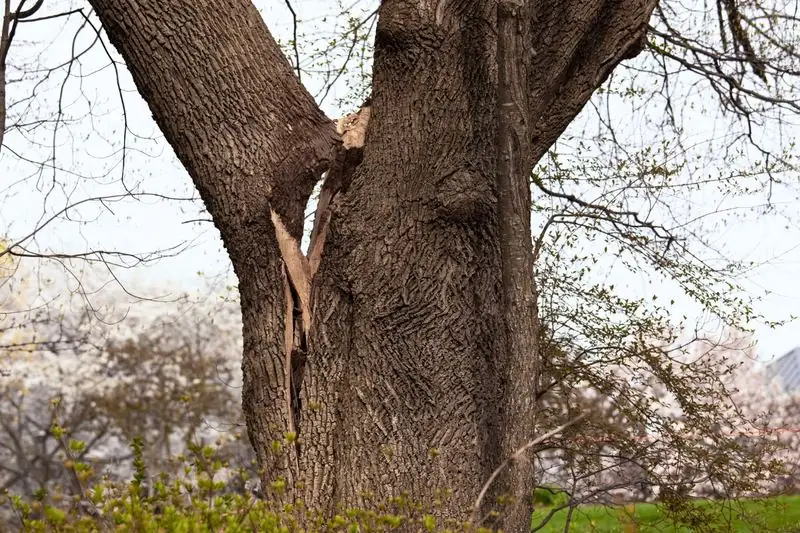
- Cracks, seams, or cavities in the trunk
- Thinning canopy or dieback at the top of the tree
- Soil heaving or cracking on one side of the tree, which can mean the roots are failing
A certified arborist can check how much sound wood is left and tell you whether the tree can be made safer with pruning, or whether it needs to come down before the next storm does the job for you.
When to Call an Arborist
If you notice any of the signs above, especially near your home, driveway, or a play area, don't wait for it to get worse. Diseases like laurel wilt and lethal bronzing spread to nearby trees, and decayed trees get more dangerous every month.
For background reading, your county's UF/IFAS Extension office is an excellent, unbiased resource on Florida tree diseases and offers plenty of free guidance for homeowners. For a hands-on look at your own trees, our certified arborists offer free on-site assessments across Central Florida. We'll tell you what we see, what can be saved, and what can't, in plain language and in writing.