After a tree comes down, you're left with a stump and a question: leave it, grind it, or pull it out completely? Leaving it costs nothing today, but in Central Florida a rotting stump tends to attract termites and other insects, sends up sprouts, and becomes a tripping hazard and a mowing headache. Most homeowners decide to deal with it. The real choice is between grinding and full removal.
What Stump Grinding Involves
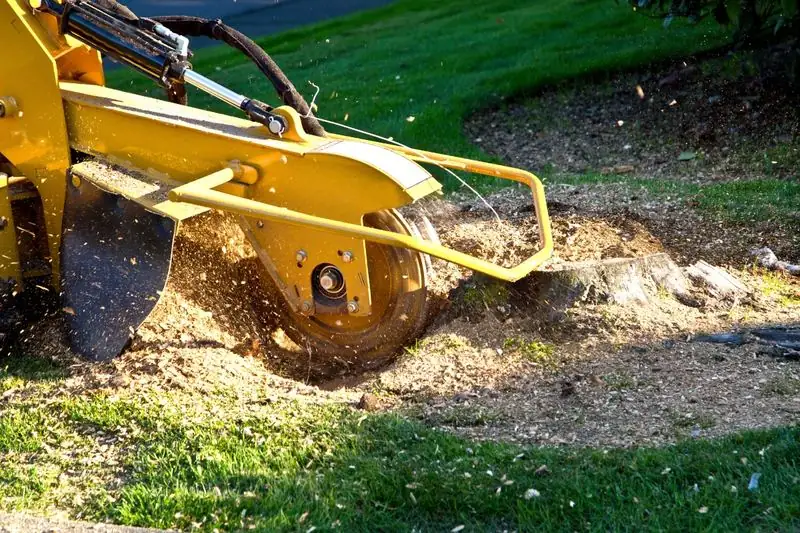
A stump grinder uses a spinning wheel with carbide teeth to chew the stump into wood chips, typically down to several inches below ground level. The major surface roots near the stump can be ground out too. The roots deeper in the ground are left to decay naturally over the following years.
- Cost: usually $100 to $500 per stump in Central Florida, depending on diameter, access, and how many stumps we grind in one visit
- Disruption: minimal. Our compact grinders fit through most garden gates and leave a small area of chips and soil
- Time: most residential stumps take under an hour each
- Result: a level area you can mulch, backfill with soil, or cover with new sod
What Full Stump Removal Involves
Full removal means digging out the stump and the main root ball, usually with an excavator or by hand around the roots. It leaves a large hole that has to be backfilled and compacted, and it disturbs a wide area of lawn, irrigation, and landscaping around it.
- Cost: considerably more than grinding, because of the equipment, labor, and backfill involved
- Disruption: significant. Expect torn-up turf, possibly damaged irrigation lines, and heavy equipment on the lawn
- Time: from a few hours to a full day, depending on the stump's size
- Result: the stump and main roots are gone, ready for construction or deep planting
Which One Should You Choose?
For most yards, grinding is the right answer. It costs less, does far less damage to the lawn, and leaves the area ready for grass or mulch within a day. Full removal makes sense mainly when:
- You are building on the spot, such as a pool, addition, slab, or driveway, and need the root mass gone
- You want to plant a new tree in exactly the same place
- The stump is from a palm with Ganoderma butt rot, where removing as much of the root system as practical is recommended
Planning to replant? Don't put a new tree right on top of a ground stump. Offset it a few feet so the new roots grow into soil instead of decaying wood chips.
What About Termites?
Decaying wood is food for subterranean termites, which are common across Central Florida. A stump left to rot near your house gives them an easy place to settle in. Grinding removes the bulk of the wood above and just below ground, which takes away most of that food source. The deeper roots break down over time underground. If termites are already active in the stump or the house is very close, it's worth mentioning to your pest control company too.
What Happens to the Chips?
Grinding produces a surprising pile of wood chips. You can keep them as mulch for garden beds, or we can haul them away and backfill the hole with clean soil so it's ready for sod. Just keep fresh chips a few inches away from the house foundation.
The Easiest Time to Grind
The best time to grind a stump is the day the tree comes down, since the crew and equipment are already on site. If you have old stumps around the yard, grinding them all in one visit costs less per stump than scheduling them one at a time.
Every estimate we write is free and itemized, so you can see the stump grinding price on its own and decide whether it's worth it for your yard.